
Meta billing architecture starts with separate control planes
A media buying operation spending $10,000 to $50,000 per day needs a billing architecture that distinguishes advertising delivery, payment collection, issuer authorization, and cash availability. Treating these as one balance is how a profitable campaign becomes an avoidable payment incident. A larger collection threshold changes the size and frequency of charges. It does not create additional bank credit, guarantee uninterrupted delivery, or confer a privileged position in the ad auction.
Meta's public billing guidance describes automatic collection when accrued advertising costs reach the payment threshold, with remaining costs also collected on the monthly bill date. Its budget guidance distinguishes payment thresholds from spending controls. Read those statements narrowly: they describe collection mechanics, not an unconditional credit facility. The account's displayed settings, billing country, currency, and eligible payment methods determine what a particular advertiser can use. [S1][S2]
This article develops an original operating model for legitimate, authorized advertising. All monetary examples are hypothetical unless replaced by authenticated customer records. A €2,000 or $2,500 threshold is a scenario input, not a universal entitlement or a promised progression. The proposed NoLimit Shopping Proprietary Ledger design below is a reference architecture; its name does not establish that any specific control has already been implemented or independently audited.
Define the variables before approving the spend plan
Use D for planned daily advertising spend, T for the current collection threshold, U for unpaid accrued advertising cost, C for currently available issuer capacity, H for pending authorization holds, and B for an internally approved contingency buffer. Keep each variable denominated in an explicit currency. If the platform reports euros and the issuer reports dollars, the two values cannot enter the same equation until an explicit conversion assumption has been applied.
At approximately uniform delivery, the expected interval between threshold crossings is 24T/D hours. At $20,000 per day and a $2,500 threshold, that interval is three hours. At a $900 threshold, it is 1.08 hours, or 64.8 minutes. These are planning averages. Intra-day delivery, prior unpaid balances, collection timing, taxes, and the monthly bill date can change the actual sequence. Finance should reconcile observed charges instead of forcing the statement into an idealized schedule.
| Daily spend | Threshold | Equivalent threshold batches per day | Average crossing interval |
|---|---|---|---|
| $10,000 | $2,500 | 4.00 | 6.00 hours |
| $20,000 | $2,500 | 8.00 | 3.00 hours |
| $50,000 | $2,500 | 20.00 | 1.20 hours |
| $20,000 | $900 | 22.22 | 1.08 hours |
| €20,000 | €2,000 | 10.00 | 2.40 hours |
Fractional batches describe long-run volume, not a fractional charge. Over a finite window, opening accrual and the final residual matter. Starting from zero with $20,000 of spend and a $900 threshold, an idealized model produces twenty-two full collections totaling $19,800 and a $200 residual. A forecasting dashboard should carry that residual into the next interval rather than discard it or falsely label it delinquent.
Evaluate threshold ladders as a capacity decision
A threshold adjustment should follow documented account eligibility and observed payment performance. Meta publishes an adjustment workflow, but the existence of that workflow is not proof that every requested value will be available. Do not publish a fabricated ladder such as a guaranteed sequence of automatic increases. Capture the actual before-and-after setting, effective time, and relevant account currency whenever the platform accepts a change. [S3]
Higher thresholds reduce the number of collection events for a fixed spend volume, but each individual authorization becomes larger. That tradeoff matters when the issuer has a per-transaction control below the platform threshold. A card with substantial remaining monthly capacity may still decline a single large charge. Conversely, a small threshold can create operational noise even when every payment succeeds. Choose the supported setting that fits documented issuer controls and the finance team's reconciliation capacity.
Consider an illustrative independent failure model with a 0.3% probability of a collection failure per attempt. Eight daily attempts imply a probability of at least one failure of 1 − 0.997^8, approximately 2.37%. Twenty-two attempts imply approximately 6.40%. This calculation explains how repeated exposure can accumulate; it does not predict either platform's decline rate. Real attempts are correlated by issuer outages, shared controls, funding shortages, and merchant behavior, and the failure probability can change with transaction size.
Therefore, a threshold decision requires both a frequency model and a severity model. Estimate the expected operational cost as collection count multiplied by measured failure probability and measured incident cost, then add liquidity and concentration costs. Re-estimate the inputs after a threshold change. A lower count of transactions is useful only if larger authorizations do not materially worsen acceptance or exhaust the available payment facility at an inconvenient time.
Separate authentication, authorization, and settlement
EMV 3-D Secure provides cardholder authentication for online card payments. Its frictionless and challenge paths reflect issuer risk assessment and authentication requirements. Authentication is not synonymous with payment authorization: an authenticated transaction can still be declined for insufficient capacity or another issuer reason. Settlement is a later financial state. A screenshot saying that a challenge succeeded cannot establish that the advertising invoice settled. [S4]
An agency cannot eliminate issuer fraud checks by choosing a prestigious card brand. Its practical responsibility is to keep authorized payer details accurate, ensure that the responsible cardholder can complete requested authentication, confirm supported recurring-payment arrangements with the issuer, and investigate failures through the official billing and issuer channels. Do not automate repeated challenges, misstate the payer's location, or treat an authentication prompt as a defect to suppress.
Model user-facing authentication latency separately from internal processing. Suppose a hypothetical frictionless path completes in 1.2 seconds, a challenge path completes in 42 seconds, and 8% of initiated authentications take the challenge path. The weighted average is 0.92 × 1.2 + 0.08 × 42 = 4.464 seconds. That average hides the operationally important tail. Report challenge rate, challenge abandonment, and the latency distribution conditional on each path, not just a blended mean.
Nor should this calculation become a recurring-billing service-level promise. Some payment events have no interactive cardholder session. Others require human intervention at a time unrelated to campaign delivery. Record timestamps for initiation, authentication request, completion, authorization result, and financial posting when those events are actually available. Mark unavailable timestamps as unknown rather than infer them from the moment someone opened a dashboard.
American Express collection is not a routing guarantee
Meta lists American Express among accepted card brands, alongside other options, subject to the payment configuration available to the advertiser. Acceptance does not imply that every commercial product, issuing country, or account currency is eligible. Confirm the live account's supported options and the issuer's terms before budgeting around any instrument. In particular, automatic card collection and bank-account direct debit are different payment arrangements and should have different labels in the finance runbook. [S5]
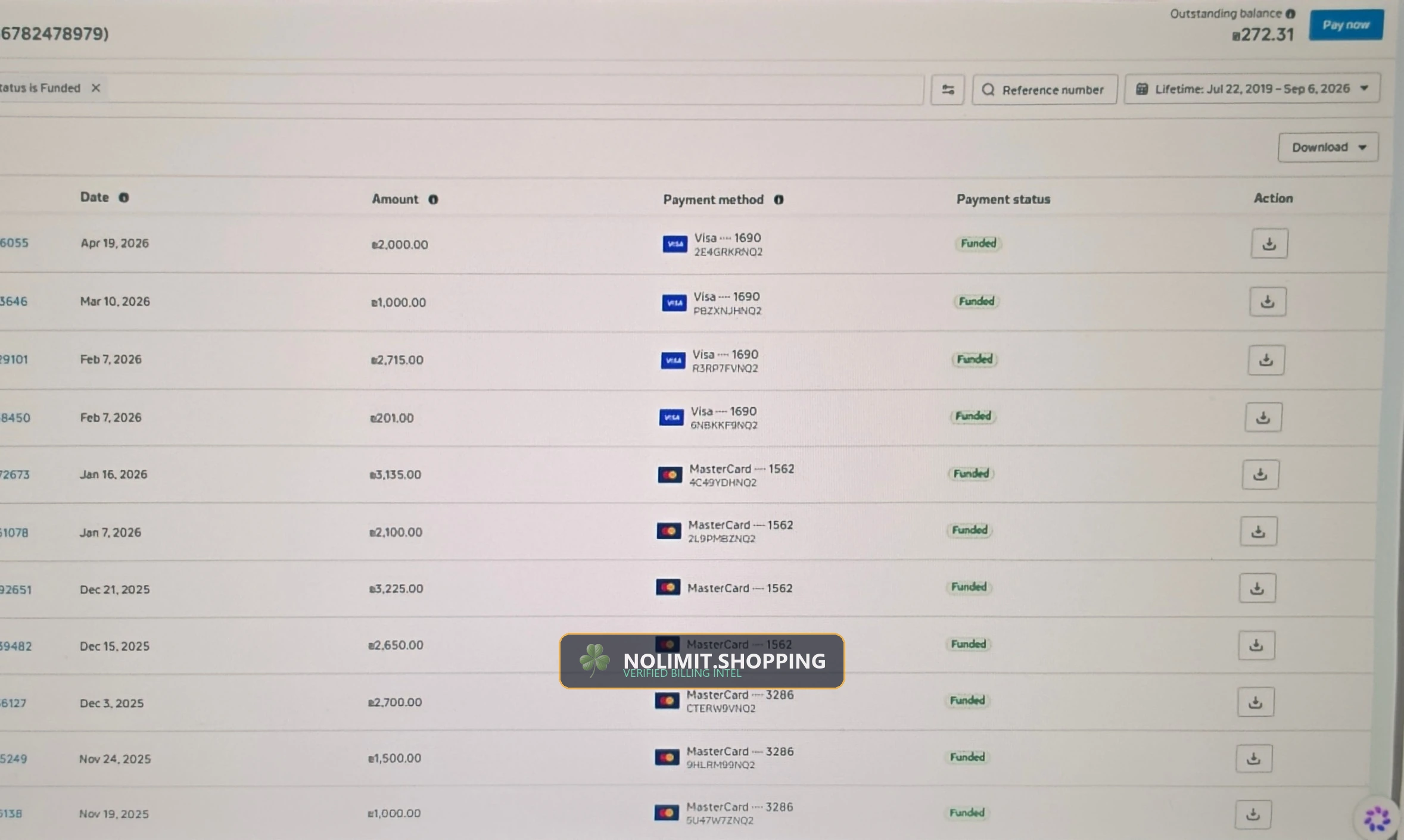
For an authorized American Express facility, record the legal payer, statement currency, available capacity, payment due dates, permitted users, and escalation contact. Have the issuer confirm how large recurring advertising charges are treated. Do not interpret a flexible spending feature as unlimited capacity. Payment reliability comes from an agreed operating arrangement, accurate account information, and adequate funds, rather than a brand-specific promise of immunity from controls.
Build liquidity coverage around the entire clearing cycle
Thresholds do not eliminate working-capital requirements. Suppose an advertiser spends $20,000 daily, requires two days of coverage before replenishment is reliably available, has $3,000 in distinct pending holds, and reserves an additional 15% of the two-day spending exposure. The planning requirement is $40,000 + $3,000 + $6,000 = $49,000. This is an illustrative liquidity policy, not a platform requirement. Only add holds separately if they are not already reflected in the capacity measure.
That final qualification prevents a common accounting error. An issuer's displayed available credit may already exclude pending authorizations. Subtracting the same holds again understates usable capacity. Conversely, using a nominal credit limit without deducting posted balances and holds overstates it. Every dashboard field needs a definition, source, timestamp, and explicit statement of whether pending items are included. The finance owner should approve those definitions before buyers depend on the calculation.
A reserve trigger can be expressed as hours of coverage: usable capacity divided by the next-hour expected spend rate. At $20,000 per day with uniform pacing, $10,000 of genuinely usable capacity represents twelve hours. During a concentrated promotion spending $2,000 per hour, the same capacity represents five hours. Use the planned hourly curve, not a daily average, for imminent payment alerts. Replenishment lead time should reflect weekends and actual treasury arrangements.
Connect billing continuity to auction economics carefully
Payment reliability protects the opportunity to participate in auctions; it does not directly purchase a lower CPM. Meta's published explanation identifies advertiser bid, estimated action rate, and ad quality as components of auction value. The exact prediction models and production coefficients are not public. A threshold screenshot cannot establish a causal improvement in auction ranking, and a reinstatement label is not an auction parameter supported by that explanation. [S6]
The useful economic identities are observable. Impressions = spend × 1,000 / CPM. If click-through rate is clicks divided by impressions and conversion rate is conversions divided by clicks, then CPA = CPM / (1,000 × CTR × CVR). At an $18 CPM, 1.5% CTR, and 4% click-to-conversion rate, CPA is $30. A 30% CPM increase to $23.40 raises CPA to $39 if the other two rates remain constant.
To preserve a $30 CPA at the higher CPM, CTR multiplied by CVR must rise from 0.0006 to 0.00078, also a 30% increase. Holding CTR at 1.5% would require CVR of 5.2%. These are arithmetic requirements, not a forecast of achievable optimization. They help a director separate a payment incident from an auction-price problem and avoid attributing every performance shift to account infrastructure.
An interrupted hour at a $20,000 daily pace represents roughly $833.33 of unspent opportunity under uniform pacing. It is not automatically $833.33 of lost profit. At a hypothetical marginal contribution of 20% of advertising spend, unrecoverable contribution would be approximately $166.67, before any later recovery or substitution. Use incremental contribution and observed recoverability when valuing an outage; revenue screenshots alone cannot support that estimate.
Specify a reconciled ledger rather than a balance counter
The proposed NoLimit Shopping Proprietary Ledger should distinguish platform accruals, payment attempts, confirmed collections, refunds, and issuer statement entries. Store monetary amounts as integer minor units with a currency code. Each imported event needs a source identifier and an idempotency key. A repeated notification must not create a second payment, and a late notification must not overwrite a later confirmed state without an explicit correction record.
The NoLimit Shopping Proprietary ACID Engine, if implemented to this specification, would atomically commit related internal entries and an audit record. Atomicity inside the ledger cannot make an external card authorization and an internal update one indivisible transaction. Use a pending state, verified external outcome, and reconciliation process for that boundary. A timeout means the outcome is uncertain until checked; it is not permission to initiate another charge blindly.
type Money = { minor: bigint; currency: 'USD' | 'EUR' };
function crossingMinutes(daily: Money, threshold: Money): number {
  if (daily.currency !== threshold.currency) throw new Error('Currency mismatch');
  if (daily.minor <= 0n || threshold.minor <= 0n) throw new Error('Positive amounts required');
  if (daily.minor > BigInt(Number.MAX_SAFE_INTEGER) ||
      threshold.minor > BigInt(Number.MAX_SAFE_INTEGER)) throw new Error('Range exceeded');
  return 1440 * Number(threshold.minor) / Number(daily.minor);
}
// Forecast only: does not initiate payments or change platform settings.
This deliberately small calculation belongs in a proposed NoLimit Pro Tools Suite billing planner. It estimates cadence without requesting card credentials. Production integration still needs a reviewed data contract, access controls, error handling, and account-specific settings. Keep credential collection outside a client-side calculator. Do not describe the tool as connected to a live payment system until that integration has actually been built and verified.
Operate failures with an explicit decision tree
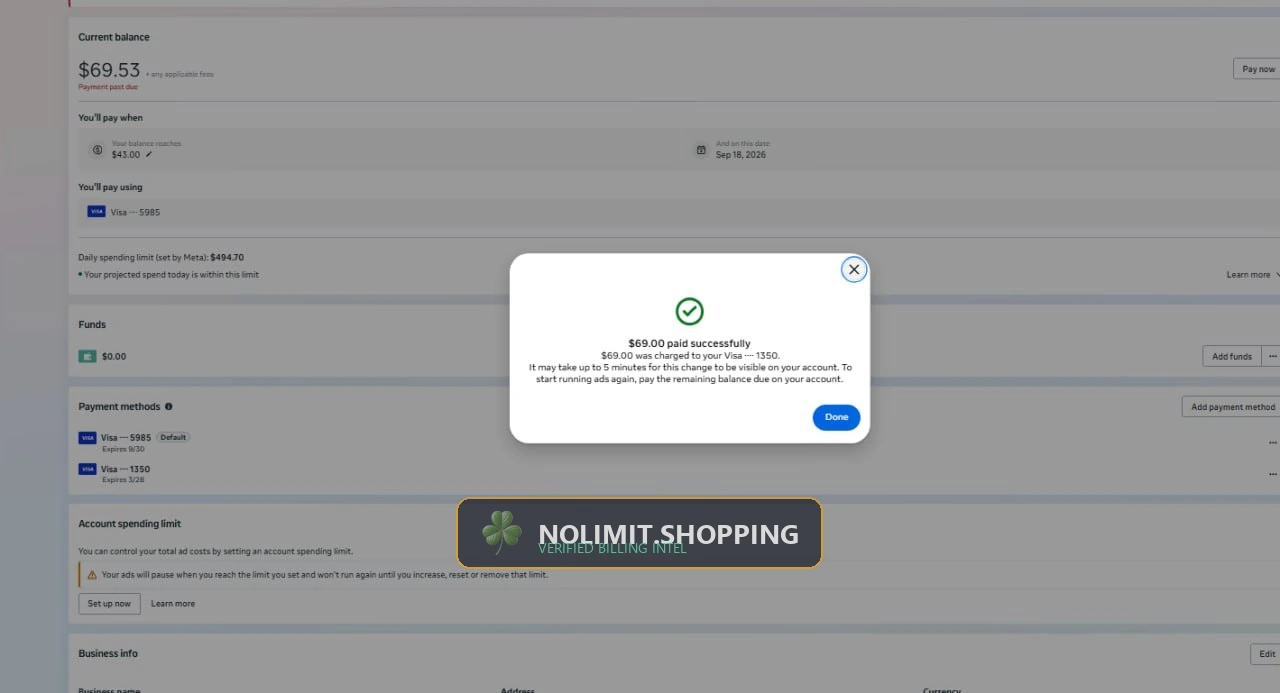
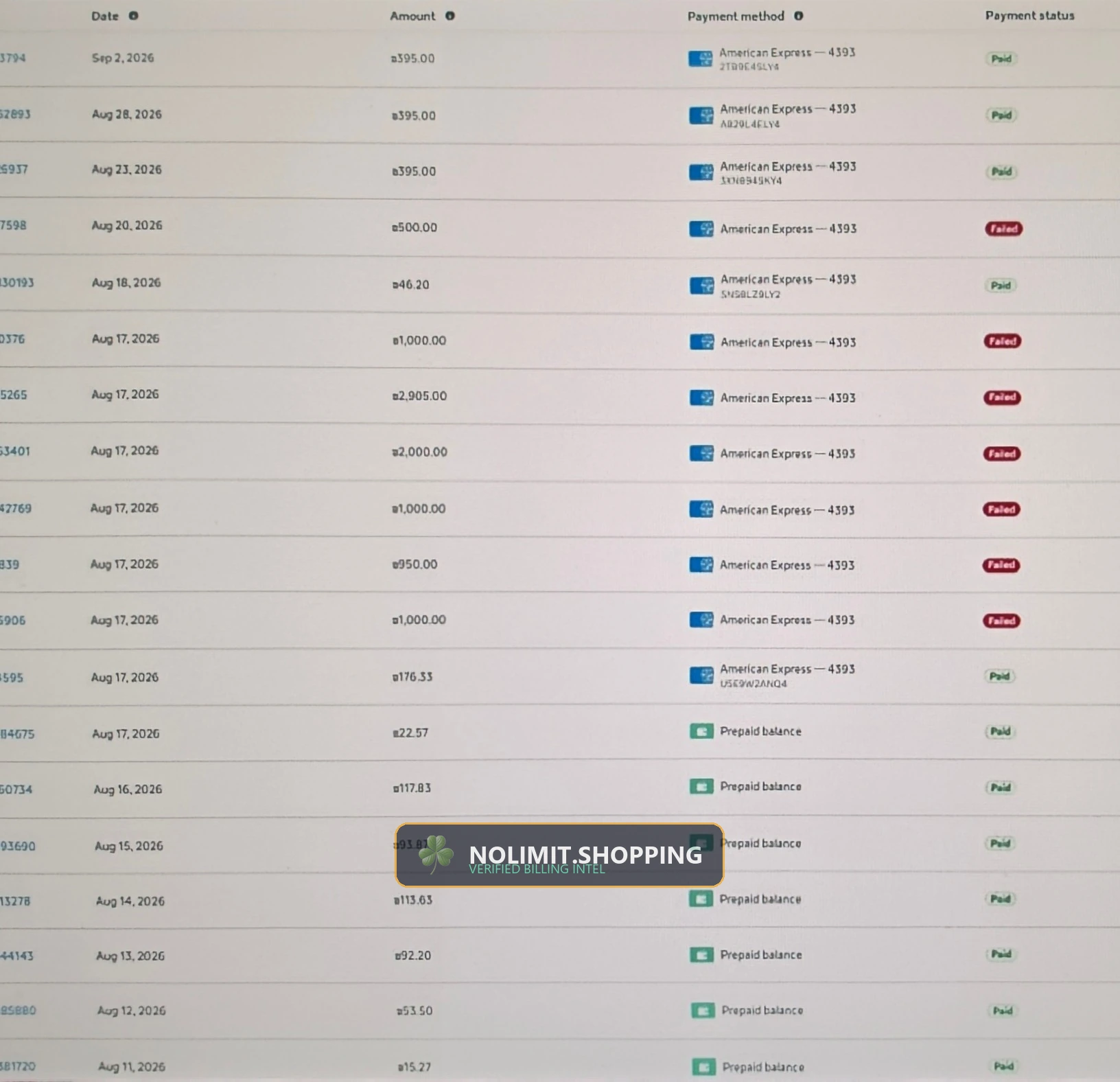
When a collection fails, first identify the affected account and invoice, then distinguish a rejected authorization from an unresolved status. Check the platform's current balance and the issuer's posted and pending activity. Confirm available capacity and the cardholder's ability to complete any official authentication request. Use the platform's supported retry or payment workflow only after the cause and previous attempt are understood. Escalate unexplained issuer declines to the issuer with the transaction reference.
If the failure affects delivery, the buying lead should record the start time and decide whether to pause planned budget increases. Finance owns payment remediation; the authorized cardholder owns authentication; the platform support owner owns the account case. A backup instrument, where supported, must belong to the authorized business arrangement and have a defined activation policy. It is not a means to avoid an unresolved restriction or hide the responsible payer.
After recovery, reconcile the invoice, inspect for duplicate pending items, and document the cause. Measure time to detection, time to diagnosis, time to confirmed payment, and time to resumed delivery separately. A paid invoice does not prove that delivery resumed immediately. Preserve both timelines and use them to revise the reserve policy, staffing schedule, and escalation thresholds for the next high-volume promotion.
Acceptance criteria for an enterprise billing launch
Before a major spend increase, require verified account currency, documented payer authority, supported payment methods, sufficient capacity under the hourly stress scenario, and a staffed escalation path. Run a reconciliation exercise using historical authorized transactions and a simulated duplicate notification. Confirm that the internal ledger preserves the opening balance, full collections, refunds, and residual accrual without silently rounding away money.
The operating dashboard should show collection success by reason category, unresolved payment age, available-capacity freshness, next expected threshold crossing, and the contribution exposed to a delivery interruption. Review these measures alongside CPM, CTR, CVR, and marginal profitability. This prevents an infrastructure team from declaring success merely because charges clear while the media buying economics deteriorate.
For NoLimit Shopping procurement discussions, ask the Admin Desk at @markzuckerads for the exact current asset description, authorization requirements, documented billing state, and written commercial terms. Keep those commercial representations separate from platform guarantees. A production-ready decision is supported by evidence specific to the account and payer, not by a headline promising that €2,000 or $2,500 collections eliminate risk.
Stress-test the operating day before increasing the limit
A launch review should include a time-based scenario rather than a single end-of-day balance. Divide the next operating day into hourly intervals, assign the planned spend in each interval, and carry forward accrued advertising costs, expected collections, replenishments, and unresolved obligations. A threshold crossing creates an expected collection event in the model, but it does not prove the exact minute at which the external system will attempt payment. Preserve a timing buffer around that uncertainty.
For example, suppose opening usable capacity is $15,000, the first six hours consume $12,000, and a scheduled replenishment of $10,000 becomes usable only after hour eight. The agency has $3,000 remaining at the end of hour six. If hours seven and eight require another $4,000, the plan has a $1,000 funding gap despite apparently adequate total daily funds. The corrective action is to change the legitimate funding schedule or approved spend plan before launch, not to assume the replenishment will arrive early.
The scenario should also include an unresolved collection. If a payment attempt times out, reserve its potential obligation until the outcome is known under the issuer's balance conventions. A second operator should not treat the uncertainty as free capacity. The incident owner needs a clear point at which planned increases are held while finance resolves the exposure. This is especially important when several buyers share one authorized payment facility but manage different campaign calendars.
Close the exercise by comparing forecast and actual hourly balances over a completed period. Investigate meaningful differences in collection timing, foreign-exchange cost, taxes, and reported spend latency. A model that consistently predicts the correct daily total but misses the lowest intraday balance is inadequate for payment continuity. The lowest point determines whether the business can fund the next obligation. Keep the model simple enough for finance to explain, but detailed enough to expose that point before it becomes an incident.
Sources and evidence scope
- [S1: Meta — When Meta charges you for ads](https://www.facebook.com/business/help/105373712886516). Collection timing; public indexed summary reviewed September 23, 2026. Full page required sign-in during research.
- [S2: Meta — Budgets, spending limits, prepaid balance, and payment thresholds](https://www.facebook.com/business/help/998181913623584). Distinction between billing and spending controls; public indexed summary.
- [S3: Meta — Adjust your payment threshold](https://www.facebook.com/business/help/1342874532544030). Adjustment workflow; public indexed summary, not account eligibility evidence.
- [S4: EMVCo — EMV 3-D Secure](https://www.emvco.com/emv-technologies/3-d-secure/). Authentication concepts; reviewed September 23, 2026.
- [S5: Meta — Accepted payment options](https://www.facebook.com/business/help/212763688755026). Card-brand listing; public indexed summary.
- [S6: Meta — Toward fairness in personalized ads](https://about.fb.com/wp-content/uploads/2023/01/Toward_fairness_in_personalized_ads.pdf). Public indexed research description of auction inputs; no private coefficients inferred.